Key Takeaways
- C9 bulbs (roughly 1.6 inches in diameter, 7 watts per LED) are significantly larger and brighter than C7s, making them the right choice for rooflines and porch rails that need to read clearly from the street or waterfront.
- A repeating 3-bulb red-white-blue sequence on 12-inch spacing is the standard for patriotic roofline runs, delivering clean color definition without visual muddle.
- Maine's July humidity and coastal salt air require UV-resistant, weatherproof C9 sockets and corrosion-resistant hardware — the same principles that govern year-round coastal Maine holiday lighting.
- Heat management matters: LED C9 bulbs run cool enough for July installs, but extension cords and outlets must be rated for outdoor use and protected from afternoon thunderstorms common across Maine in summer.
- Professional installation, removal, and storage — especially for commercial and municipal displays — protects your investment and eliminates ladder risk on steep Maine rooflines.
Picture the Kennebec River at dusk on July 3rd: a row of Victorian homes along the bluff draped in bold red, white, and blue C9 bulbs that shimmer off the water all the way across to the opposite bank. That's not an accident — it's intentional design, correct bulb sizing, and smart sequencing working together. Maine's 4th of July is one of the most visually charged holidays of the summer season, and the right outdoor lighting display turns a front porch into a neighborhood landmark. Whether you're dressing up a downtown commercial block in Bangor, lighting the rails of a Boothbay Harbor cottage, or adding patriotic flair to a Camden hilltop home, understanding C9 bulbs and how to deploy them in Maine's specific summer environment is the difference between a display that impresses and one that just disappears into the daylight.
C9 vs. C7 Bulbs: Why Size and Visibility Matter for Patriotic Displays
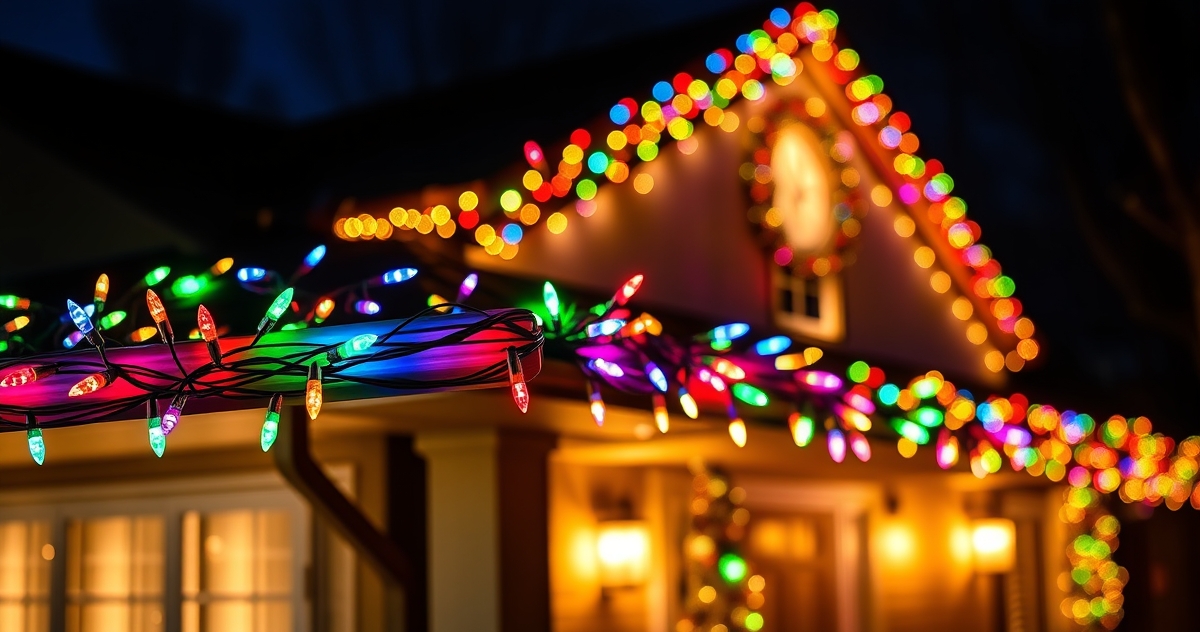
C9 bulbs are the right choice for large-scale patriotic outdoor displays because their larger diameter — approximately 1.6 inches compared to the C7's 1.25 inches — produces a dramatically wider, more saturated cone of color that reads clearly from distances of 50 feet or more. That visibility gap matters enormously when your goal is a roofline display that neighbors, parade-goers, or waterfront visitors can appreciate from across the street or across the cove.
- C9 bulbs: ~1.6-inch diameter, E17 base, typically 5–7 watts per LED, spacing commonly 12–18 inches on the cord
- C7 bulbs: ~1.25-inch diameter, E12 candelabra base, typically 3–5 watts per LED, spacing commonly 9–12 inches on the cord
For patriotic red-white-blue sequences, C9s produce a purer, richer color output because the larger frosted or transparent shell diffuses more light through the colored pigment. A warm red C9 glows with real depth; a red C7 at the same distance can look washed out or indistinct, especially in Maine's long summer twilight hours when ambient light competes with your display. C7s remain excellent for closer-range detail work — wrapping porch columns, outlining window frames, or accentuating garlands and wreaths — but the workhorse of any serious 4th of July roofline run is the C9.
| Feature | C9 Bulb | C7 Bulb |
|---|---|---|
| Diameter | ~1.6 inches | ~1.25 inches |
| Base type | E17 intermediate | E12 candelabra |
| Typical LED wattage | 5–7W | 3–5W |
| Best spacing on cord | 12–18 inches | 9–12 inches |
| Visibility distance | 50–100+ feet | 20–50 feet |
| Best use case | Rooflines, long porch rails, commercial facades | Column wraps, window trim, accent details |
Roofline and Porch-Rail Spacing for Red, White & Blue Sequences
The most visually compelling patriotic C9 display uses a strict repeating sequence — red, white, blue — on consistent spacing, typically 12 inches on center for roofline runs and 9–12 inches for porch rails where viewers are closer. Deviation from the sequence, even by a single bulb, breaks the rhythmic color pattern and reads as an error from the street.
Roofline Runs
For a standard gable-front Maine home, measure your roofline total run in feet and divide by your chosen spacing (12 inches = 1 foot per bulb) to calculate the number of C9 sockets needed. Always plan your sequence to begin and end on the same color — ideally red — at each corner or peak, so the display looks intentional from every angle. On a 60-foot roofline run at 12-inch spacing, you'll need 60 sockets: 20 red, 20 white, and 20 blue in repeating groups of three.
- Use SPT-1 or SPT-2 commercial-grade C9 cord rated for outdoor use — residential zip cord degrades quickly in Maine's UV-heavy July sun.
- Install clips rated for asphalt shingles or metal roof edges depending on your roofing material. Avoid adhesive clips in salt-air environments; they release prematurely in humidity.
- Keep each individual cord run to no more than 210 feet or 150 sockets before connecting to a new circuit to stay within safe wattage loads.
Porch Rail and Stair Displays
Porch rails place the display at eye level, so the color sequencing reads even more critically here. Use 9-inch spacing for a denser, more vibrant effect, and consider anchoring the cord to the underside of the top rail with small cable staples rather than allowing it to hang freely — this keeps the display taut and uniform even in Maine's summer afternoon breezes off the ocean. For stair rails, mirror the sequence from both sides so the display reads as symmetrical when viewed from the walkway.
Explore our full range of residential holiday lighting services to see how we handle both seasonal patriotic installs and permanent solutions for Maine homeowners.
Working with Maine's Humid Summer Air and Coastal Salt Environment
Maine's July climate is genuinely demanding on outdoor lighting hardware: high humidity inland, salt-laden air along the coast, and afternoon thunderstorms that arrive fast and hit hard. The same environmental factors that make coastal Maine holiday lighting a specialized discipline apply equally to your 4th of July C9 display.
Hardware Selection for Salt Air
- Choose nickel-plated or stainless-steel socket contacts rather than standard brass, which corrodes visibly within a single season in coastal Maine conditions.
- Use waterproof SPT-2 cord with a UV-stabilized PVC jacket — the sun in July beats down on south-facing rooflines for 10+ hours a day, and cheap cord cracks within weeks.
- Apply dielectric grease to each bulb base before screwing it in; this prevents oxidation between the E17 base and socket, which is one of the most common causes of intermittent outages in salt-air displays.
- Stainless or galvanized installation clips resist the salt-accelerated rust that makes standard steel clips fail mid-season.
Outlet and Power Management
Every outdoor outlet used for your July 4th display must be GFCI-protected — this is Maine electrical code and basic safety practice. Check that your outdoor outlets have functioning GFCI reset buttons and test them before connecting any display. If you're running multiple circuits for a large display, use a covered power strip rated for outdoor use and position it off the ground under porch overhangs or inside a weatherproof enclosure to prevent water intrusion from the heavy rain events typical of a Maine July.
Safe Installation Practices for July Heat and Summer Conditions
July installation in Maine is physically safer than December work in many respects — no ice, no frozen fingers — but summer heat and ladder safety on steep rooflines still demand careful practice. LED C9 bulbs generate minimal heat themselves (surface temperatures rarely exceed 95°F even in direct sun), which is one of the strongest arguments for choosing LEDs over incandescent C9s for summer displays.
- Install in the morning: Maine rooftops in direct July afternoon sun can exceed 150°F surface temperature. Work between 7 a.m. and 11 a.m. before peak heat.
- Use a standoff ladder on uneven ground: Many Maine homes sit on granite ledge or sloped lots where ladder footing is unpredictable. Stabilizer arms are non-negotiable.
- Secure cords before a storm: If NOAA issues a thunderstorm watch for your region — common across interior Maine in July — disconnect displays and secure any loose cord runs before high winds arrive.
- Test your full sequence on the ground first: Roll out the cord, screw in all bulbs in sequence, and plug in to verify every socket works before you climb. Discovering a dead socket at 20 feet is avoidable.
- Plan removal now: The sun and humidity of a Maine summer will work into cord connections over four to six weeks. Schedule removal promptly after July 4th to prevent bonding and degradation — or let our team handle professional removal and storage so your hardware stays in top condition for future seasons.
If you're planning ahead or want year-round curb appeal beyond a single holiday, our guide to planning holiday lighting installation in Maine during summer walks through how early-season prep saves time and money across every occasion.
Commercial and Municipal 4th of July Displays Across Maine
Commercial storefronts, downtown districts, and municipal waterfront areas represent some of the most impactful opportunities for patriotic C9 displays in Maine. A single well-lit commercial block creates a visual anchor for community celebrations and draws foot traffic during evening festivities. Municipal clients — from small harbor towns to larger city centers — benefit from coordinated roofline and streetscape lighting that can be installed efficiently and removed cleanly after the holiday weekend.
For commercial properties and municipal clients, we recommend pre-assembled C9 cord sections with color-coded plugs so that red, white, and blue zones can be installed in parallel by multiple crew members, cutting installation time significantly. Large runs — think a 200-foot commercial facade — require careful circuit planning to distribute load across multiple 15- or 20-amp outdoor circuits and avoid tripping breakers during peak display hours when adjacent businesses are also drawing power.
Municipalities coordinating displays for parade routes or waterfront celebrations should schedule installation at least one week before July 4th to allow time for troubleshooting and any necessary hardware replacements. Contact our team through our full services overview or request a free estimate to discuss your commercial or municipal project scope.
Frequently Asked Questions
What is the best bulb spacing for a red, white, and blue C9 sequence on a Maine home roofline?
The standard and most visually effective spacing for a patriotic C9 roofline display is 12 inches on center, using a repeating three-bulb sequence of red, white, and blue. This spacing ensures that each individual color reads distinctly from street level — closer spacing can cause colors to blur together at distance, while spacing beyond 18 inches creates visible gaps in the display. On porch rails where viewers are within 10–15 feet, you can tighten to 9-inch spacing for a richer, denser effect.
How do C9 LED bulbs hold up in Maine's coastal salt air during summer?
Quality LED C9 bulbs in UV-stabilized, weatherproof sockets perform well in Maine's coastal salt air when paired with the right hardware. The key is using nickel-plated or stainless socket contacts rather than standard brass, applying dielectric grease to each bulb base at installation, and choosing SPT-2 outdoor-rated cord with a UV-resistant jacket. Without these precautions, salt oxidation can cause intermittent outages within a single season. For detailed guidance on coastal-specific lighting practices, see our post on holiday lights for coastal Maine saltwater homes.
Can I leave C9 patriotic lights up for the entire summer season in Maine?
While C9 LED bulbs are durable, we recommend removing displays within one to two weeks after July 4th rather than leaving them up all summer. Prolonged UV exposure degrades cord insulation, extended humidity causes socket oxidation, and Maine's August storms can stress clips and hardware beyond their design limits. Prompt removal also preserves your cord and bulbs for future seasons. Our removal and storage service handles this efficiently and keeps your equipment in top condition.
How many C9 bulbs do I need for a typical Maine colonial-style home?
A typical two-story Maine colonial with a 40-foot front roofline, a 25-foot porch rail, and two gable peaks will require approximately 80–100 C9 sockets at 12-inch spacing. At a red-white-blue repeating sequence of three, round your total socket count up to the nearest multiple of three to maintain a complete, symmetrical sequence. Always purchase 10–15% extra bulbs in each color as replacements, since minor variance in manufacturing means occasional early burnout even with quality LEDs.
Is professional installation worth it for a July 4th C9 display?
For most Maine homeowners with steep rooflines, two-story facades, or coastal properties, professional installation delivers real value beyond convenience. Professionals bring commercial-grade materials, proper ladder equipment for uneven Maine terrain, correct circuit planning, and the expertise to build a display that looks polished and performs reliably. For commercial properties and municipal clients, professional installation is essentially essential for scale, safety compliance, and post-event removal efficiency. Contact us for a free estimate and we'll scope your project clearly.
What colors of C9 bulbs look best for a Maine waterfront 4th of July display?
For waterfront displays visible across open water, choose deep red (sometimes labeled "cherry" or "ruby"), pure cool white, and royal or cobalt blue C9 bulbs rather than warmer variants. Cool white reads crisply against dark water at twilight, and saturated primary red and blue hold their color definition in the long Maine summer dusk. Avoid warm-white or pastel variants in large roofline runs — they lose distinction at distance and dilute the patriotic palette's visual impact.
Ready to make your Maine home, business, or community event unforgettable this 4th of July? Our team at Holiday Lights Decor Maine designs, installs, and removes professional C9 patriotic displays across the state — from York County to Aroostook. Contact us today for a free estimate and let's light up your Independence Day right.